 Felix Kumuyi
Deep Blue Project Cuts Gulf of Guinea Piracy by 70%, as Nigeria Graduates Elite Maritime Security Operatives
By Felix Kumuyi

CROSS-SESSION of dignitaries at the event
Nigeria’s maritime security success story came into sharp focus on Thursday as the Federal Government disclosed that piracy incidents in the Gulf of Guinea have dropped by over 70 per cent since the launch of the Deep Blue Project, while Nigeria has maintained zero piracy attacks within its territorial waters for four consecutive years.
The milestone was highlighted during the 2026 Graduation Ceremony and Capability Presentation of the Deep Blue Project Task Group held at the 5th Battalion Army Barracks, Elele, Rivers State, where newly trained maritime security operatives showcased advanced combat and rescue capabilities in a high-level tactical demonstration.

Chief Adegboyega Oyetola CON, Hon Minister of Marine & Blue Economy at the Elele Venue
Speaking at the event, the Minister of Marine and Blue Economy, Adegboyega Oyetola, described the Deep Blue Project as a game changer that has transformed Nigeria’s maritime security architecture and restored international confidence in the nation’s waterways.
According to the Minister, before the establishment of the project in 2021, the Gulf of Guinea was regarded as one of the world’s most dangerous maritime corridors, accounting for over 45 per cent of global piracy incidents and more than 90 per cent of global crew kidnappings at sea during its peak.
“It was against this backdrop that the Federal Government conceived and commissioned the Integrated National Security and Waterways Protection Infrastructure, popularly known as the Deep Blue Project, to combat piracy, sea robbery, illegal fishing, oil theft and other maritime crimes,” Oyetola stated.
He noted that through the deployment of integrated air, land and sea assets backed by advanced surveillance and rapid response systems, the project has significantly improved maritime security across Nigeria’s waters and the Gulf of Guinea.

Dr Dayo Mobereola, DG NIMASA, at the event
“I am proud to state that Nigeria has recorded zero piracy incidents within its territorial waters for the past four years, while piracy incidents across the Gulf of Guinea have reduced by over 70 per cent,” the Minister declared.
Oyetola explained that the improved security situation has enhanced regional maritime safety, boosted trade activities, restored global shipping confidence and strengthened Nigeria’s reputation as a responsible maritime nation.
He further disclosed that the gains recorded under the Deep Blue Project have intensified international calls for the removal of War Risk Insurance Premiums imposed on Nigerian-bound cargoes, a development expected to reduce shipping costs, improve port competitiveness and stimulate trade and investment within the maritime sector.

Some of the trained Cadets in Action
The Minister revealed that the Ministry of Marine and Blue Economy is currently evaluating strategic plans to expand the Deep Blue Project into critical coastal areas including Igbokoda, Bakassi and other vulnerable maritime corridors to further strengthen Nigeria’s maritime security architecture.
He described the graduating personnel as a new generation of highly trained and disciplined operatives equipped to sustain the achievements already recorded under the project.
“Your successful completion of this rigorous training reflects not only personal dedication and sacrifice but also your readiness to serve the nation with professionalism, courage and integrity,” Oyetola charged the graduands.
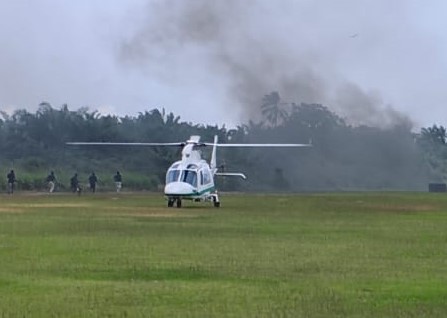

Some Rescue demonstration Scenes
Also speaking, the Chief of the Naval Staff, Vice Admiral Idi Abbas, described the Deep Blue Maritime Security Unit as a strategic force multiplier supporting Nigeria’s maritime security operations.
Represented at the event, the Naval Chief stated that the advanced combat and maritime capability training aligns with the Suppression of Piracy and Other Maritime Offences (SPOMO) Act 2019, which mandates collaboration between the Nigerian Navy and NIMASA in maritime law enforcement and capacity development.
He noted that the four-month intensive training programme, which commenced in January 2026, included advanced combat recurrency training, C4I operational capacity, unmanned aerial systems deployment, fast-roping exercises, helicopter support operations and integrated maritime security tactics.
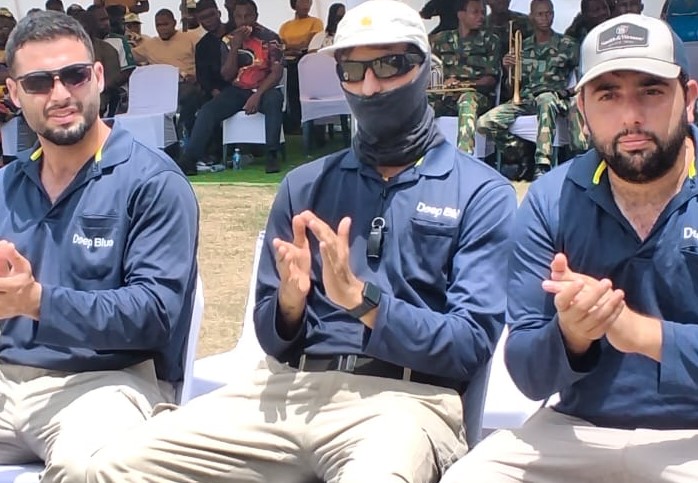
Some of the Trainers
“The achievements of the Deep Blue Task Group have supported the Nigerian Navy in shaping security outcomes within Nigeria’s maritime domain and the littorals,” the Naval Chief stated.
Vice Admiral Abbas urged the graduands to remain disciplined, loyal and professional in the discharge of their duties, reminding them that the nation’s expectations of the Armed Forces and maritime security agencies remain high.


Some Lagos Journalists on ground to witness the event
A major highlight of the event was the live operational capability demonstration, which featured the successful repelling and disarming of simulated pirates by Deep Blue personnel using two Deep Blue helicopters, combat armoured vehicles, interceptor assets and other tactical platforms.
The exercise also showcased coordinated rescue operations, aerial surveillance capabilities and rapid tactical response strategies designed to secure Nigeria’s maritime environment against emerging threats.

The ceremony underscored the Federal Government’s continued commitment under President Bola Ahmed Tinubu to strengthening maritime security as a critical driver of economic growth, trade facilitation, investment and the development of Nigeria’s blue economy.


 admin