 admin
Oyetola Unveils NPERA Act as FG Pushes Port Reforms, Approves Six Deep Seaports
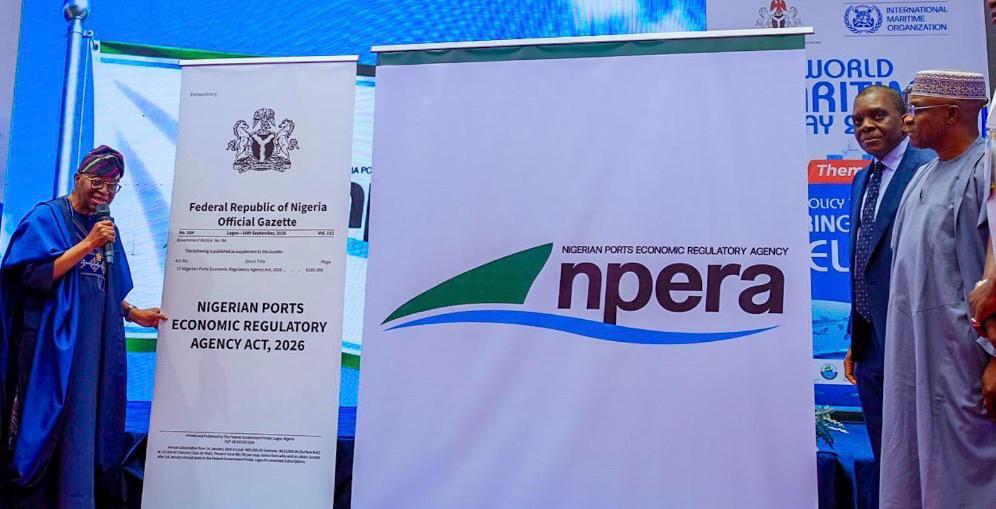
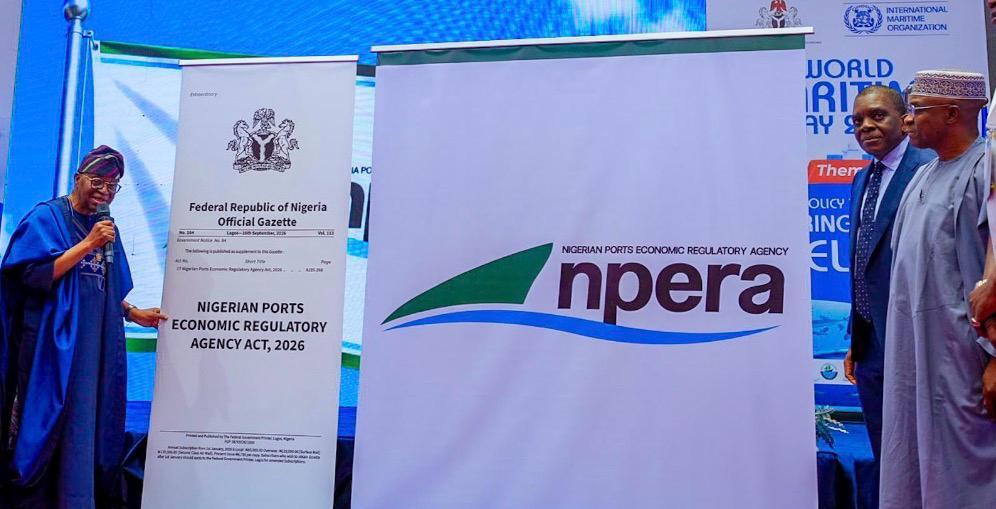
L-R: Minister of Marine and Blue Economy, Dr. Adegboyega Oyetola, unveiling the newly gazetted Nigerian Ports Economic Regulatory Agency (NPERA) Act, 2026 and the new agency’s logo at the third quarter stakeholders’ engagement of the Federal Ministry of Marine and Blue Economy, in Victoria Island, Lagos, on Friday
The Federal Government has unveiled the gazetted Nigeria Ports Economic Regulatory Agency Act, 2026, while outlining plans to modernize existing ports, accelerate indigenous shipping development and attract investment into the marine and blue economy.
Nigeria’s drive to strengthen its maritime industry has entered a new phase with the unveiling of the Nigeria Ports Economic Regulatory Agency (NPERA) Act, 2026, as the Federal Government moves to establish a dedicated regulatory framework for the country’s port sector.
The Minister of Marine and Blue Economy, Dr Adegboyega Oyetola, unveiled the gazette Act and presented the agency’s official logo on Friday, October 16, 2026, during the ministry’s Third Quarter Citizens’ and Stakeholders’ Engagement in
Victoria Island, Lagos.
The development follows President Bola Ahmed Tinubu’s assent to the Act in June 2026 and is expected to provide a statutory foundation for regulating port economic activities, promoting fair competition and improving the operating environment for businesses across the maritime value chain.
For an industry where port charges, service delivery and regulatory clarity can significantly influence the cost of international trade, the establishment of NPERA marks an important step towards creating a more structured and predictable system for port users and service providers.
Oyetola disclosed that he had directed the immediate constitution of a ministerial committee to oversee the transition of the Nigerian Shippers’ Council (NSC), which has served as Nigeria’s interim port economic regulator since 2014, into the new agency.
Under its statutory mandate, NPERA will regulate tariffs and charges, promote fair competition, enforce service standards, resolve commercial disputes and protect the interests of port users.
These responsibilities will place the agency at the centre of efforts to address some of the concerns affecting port operations, particularly the need for transparent charges, effective dispute resolution and consistent service standards.
Shipping companies, terminal operators, freight forwarders, importers and exporters all depend on an operating environment where regulatory responsibilities are clear and commercial disagreements can be resolved fairly.
However, the minister stressed that the effectiveness of the new agency would depend on its ability to operate independently and impartially.
“The credibility of an economic regulator rests, in no small measure, on its independence, impartiality and freedom from responsibilities that could give rise to actual or perceived conflicts of interest,” Oyetola said.
He directed that NPERA function as an impartial arbiter, free from competing regulatory and operational responsibilities that could undermine its credibility.
The transition from the Nigerian Shippers’ Council’s interim regulatory role to the new agency will therefore be a significant test of the government’s commitment to building an effective port regulatory system.
Beyond establishing the agency, the government is also pursuing a broader programme to improve port infrastructure and expand Nigeria’s capacity to handle maritime trade.
Oyetola identified Apapa, Tin Can Island, Onne, Rivers, Delta and Calabar ports as key beneficiaries of the planned modernisation programme, stressing that the initiative would cover the entire national port system.

The New NPERA Logo
“No part of our national port system will be left behind in this modernisation programme,” he declared.
The commitment signals an effort to expand the role of ports outside Lagos in supporting trade and economic development, while reducing the concentration of port activity in the country’s busiest maritime gateway.
For coastal communities and businesses in the Niger Delta and other parts of the country, improvements in port infrastructure could create new opportunities for investment, logistics services, employment and industrial development.
The minister also announced that the Federal Government had approved the development of six deep seaports: Ibom, Bakassi, Agge, Gateway, Ondo and Bonny.
The proposed projects are expected to expand Nigeria’s port capacity and strengthen its position as a regional logistics hub.
If successfully developed, the facilities could provide additional gateways for cargo movement, support industrial activities and improve access to international markets. Their impact, however, will depend on effective implementation, sustainable financing, adequate road and rail connections, and the ability to attract private-sector investment.
For the projects to deliver their full economic potential, port development must be supported by efficient cargo evacuation systems and strong connections to manufacturing centres, distribution networks and hinterland markets.
Maritime security also featured prominently in the minister’s address, with Oyetola highlighting progress recorded through the government’s Deep Blue Project.
He credited the initiative with helping Nigeria maintain zero piracy incidents in its territorial waters and described the lifting of the United States Coast Guard’s 12-year Condition of Entry on vessels arriving from Nigeria in August 2026 as a significant achievement.
The development, he said, reflected improvements in maritime security and compliance with the International Ship and Port Facility Security Code.
Maintaining a secure maritime environment is essential to sustaining confidence among international shipping operators and investors. It can also help reduce security-related operational risks and support the growth of shipping, port services and other activities within the blue economy.
On indigenous shipping development, Oyetola reaffirmed the government’s commitment to expanding the participation of Nigerian operators in the maritime industry.
He disclosed that he had directed the Nigerian Maritime Administration and Safety Agency (NIMASA) to work with approved Primary Lending Institutions to accelerate the processing and disbursement of the Cabotage Vessel Financing Fund to qualified applicants.
The fund is intended to support eligible indigenous operators seeking to acquire vessels and strengthen their capacity to participate in domestic shipping and related maritime services.
Faster access to financing could help qualified operators address capital constraints, expand their fleets and improve their ability to compete. The practical impact will depend on the efficiency of the disbursement process and the extent to which beneficiaries can deploy the funds productively.
Oyetola also highlighted the role of international partnerships in developing Nigeria’s marine and blue economy, citing the country’s election to Category C of the International Maritime Organization (IMO) Council in November 2025 and ongoing engagements with Denmark, India, Norway and the United Kingdom.
He said international cooperation should produce practical outcomes through technology transfer, capacity building, investment and the development of local expertise.
“Our approach to international cooperation is purposeful and results-oriented,” the minister stated.
The importance of these partnerships was reinforced by a presentation from the Ambassador of Denmark to Nigeria, Jens Ole Bach Hansen, titled “Denmark’s Experience in Building a Sustainable Blue Economy: Lessons for Strategic Partnerships, Investment and Technology Transfer with Nigeria.”
The presentation examined how Nigeria could draw on international experience to develop its marine resources, attract investment and strengthen the technical capabilities needed to compete in the global maritime economy.
Denmark’s experience also provided a platform for discussions on sustainable development and the role of partnerships in unlocking the economic potential of maritime resources.
The stakeholder engagement, themed “Building Strategic Bilateral Partnerships for Sustainable Growth, Investment, and Technology of Nigeria’s Marine and Blue Economy,” brought together government officials, industry leaders, development partners and other stakeholders to discuss the sector’s opportunities and challenges.
The discussions came against the backdrop of Nigeria’s efforts to turn its strategic coastal location and maritime resources into stronger economic returns through trade, investment, job creation and industrial development.
The unveiling of the NPERA Act represents one part of that wider ambition. A clear and credible regulatory framework could help improve investor confidence, but the agency’s effectiveness will ultimately be determined by how it regulates port charges, handles commercial disputes, enforces service standards and ensures fair competition.
Likewise, the planned modernisation of existing ports and development of new deep seaports will require sustained investment, efficient transport infrastructure and effective coordination among government agencies and private-sector operators.
For indigenous shipping companies, the timely and transparent disbursement of the Cabotage Vessel Financing Fund will be an important measure of progress in efforts to strengthen local participation.
Taken together, the initiatives outlined by Oyetola reflect the government’s intention to address port regulation, infrastructure, maritime security, indigenous shipping and international cooperation as interconnected parts of Nigeria’s maritime development.
The immediate priority, however, will be implementation.
The transition to NPERA must establish a regulator capable of operating transparently and independently, while port modernisation and deep seaport projects must move beyond approvals and policy announcements to deliver measurable improvements in capacity and efficiency.
For importers and exporters, the expected benefits include a more predictable regulatory environment and improved port services. For shipping companies and terminal operators, clear rules and fair competition could support more efficient operations. Investors will be looking for consistency, transparency and confidence that regulatory decisions will be applied fairly.
Ultimately, the success of the reforms will be measured not by the unveiling of an Act or the launch of an agency’s logo, but by the changes experienced by businesses and other users of Nigeria’s ports.
As the Federal Government advances its maritime development agenda, the challenge will be to translate its commitments into a port system that supports trade, attracts investment, creates employment and strengthens Nigeria’s position in the regional and global maritime economy.