 Felix Kumuyi

Lagos Free Trade Zone Customs Hits Historic Revenue Milestone, Rakes in ₦408.9bn in 6 Months

Nigeria’s drive to position itself as West Africa’s leading trade and investment hub received another major boost as the Nigeria Customs Service (NCS), Lagos Free Trade Zone Command, generated a record-breaking ₦408.87 billion in the first half of 2026. The feat, achieved under the leadership of Comptroller Hauwa Kulu Anifowoshe-Abubakar, highlights the growing economic significance of the Lagos Free Trade Zones and Lekki Deep Sea Port, where improved compliance, stronger stakeholder collaboration and seamless trade facilitation are translating into unprecedented revenue growth.
Comptroller HKA Abubakar, CAC, Lagos Free Trade Zone, NCS
The Lagos Free Trade Zone Command of the Nigeria Customs Service has reinforced its position as one of the country’s fastest-growing revenue-generating formations after posting an impressive ₦408.87 billion in revenue between January and June 2026.
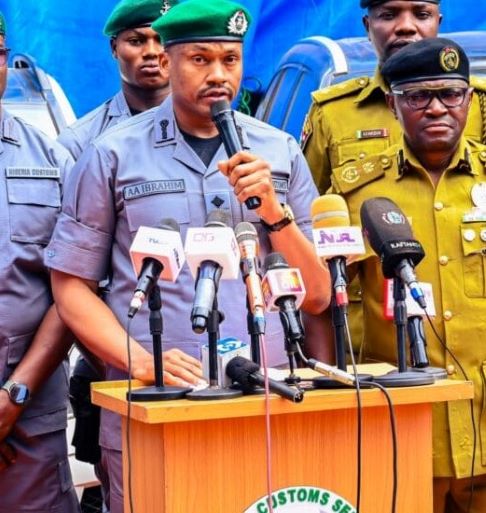
Speaking during the Command’s Half-Year Media Briefing in Lagos, the Customs Area Controller, Comptroller Hauwa Kulu Anifowoshe-Abubakar, attributed the remarkable performance to strategic reforms, improved operational efficiency and sustained collaboration with stakeholders operating within the Lagos Free Trade Zones and the Lekki Deep Sea Port.
The Command also recorded its highest monthly revenue since inception, generating ₦87.1 billion in June 2026 alone—a milestone the Controller described as evidence of increasing investor confidence and the effectiveness of the Nigeria Customs Service’s trade facilitation reforms.
According to her, the first-half revenue represents an increase of ₦91.55 billion over the ₦317.32 billion realised during the corresponding period in 2025, reflecting an impressive growth of 28.85 per cent.
Comptroller Anifowoshe-Abubakar explained that the achievement was driven by deliberate efforts to strengthen compliance, improve operational processes and deepen engagement with importers, exporters, licensed customs agents and investors.
She noted that since its establishment four years ago, the Lagos Free Trade Zone Command has evolved into a model Customs formation, providing efficient cargo processing and creating an enabling environment for legitimate trade while supporting Nigeria’s industrialisation agenda.
The Controller credited the outstanding performance to the visionary leadership of the Comptroller-General of Customs, Bashir Adewale Adeniyi, whose reforms continue to modernise Customs operations through innovation, collaboration and technology-driven processes.
She also commended officers and men of the Command for their professionalism, discipline and dedication, saying their commitment has strengthened the confidence of the trading community and enhanced the ease of doing business.
Appreciating the cooperation of sister security agencies, terminal operators and business stakeholders, Comptroller Anifowoshe-Abubakar assured investors that the Command would continue to promote transparency, trade facilitation and strict compliance with the Nigeria Customs Service Act, 2023.
She pledged that the Command would consolidate on its achievements in the second half of the year by improving service delivery, sustaining stakeholder engagement and surpassing its current revenue performance without compromising national security or regulatory compliance.
As part of the media briefing, the Command also organised a stakeholder sensitisation programme on proper documentation for Transire cargo movements.
The technical session, facilitated by Assistant Comptroller A. Uguda and Assistant Comptroller O.A. Omekan, focused on the legal requirements governing the transfer of cargo from mother ports to bonded terminals, jetties and free zones under the Nigeria Customs Service Act, 2023.
The officers emphasised that proper documentation remains the foundation of Customs control, revenue protection and efficient cargo movement, warning that incomplete declarations, altered seal numbers, incorrect cargo descriptions and missing manifests expose importers to delays, revenue losses and legal sanctions.
They explained that accurate documentation accelerates cargo clearance, reduces processing time, prevents smuggling and fraud, improves traceability and strengthens government revenue collection.
The presenters urged shipping companies, terminal operators, freight forwarders and bonded terminal operators to embrace full compliance with the provisions of Sections 147, 152, 153 and 155 of the Nigeria Customs Service Act, stressing that regular stakeholder education remains critical to safeguarding the integrity of cargo movement within Nigeria’s rapidly expanding Free Trade Zones.

 admin